Announcing the 2008 Golden Teddy Awards

UPDATE: My Golden Teddy Awards have nothing to do with the Golden Teddy Awards handed out by, ha, The Teddy Bear Review (a magazine that “embraces the joy of Teddy Bear and soft scultpure collecting”). Really. I didn’t know those awards existed until I saw people googling “Golden Teddy Bear Awards” on my site meter. And there was no reason why anyone would know about my awards in, say, Dunkirk.

It’s that time of year again! Yes, it’s late December, when critics, unions, and amorphous over-funded foundations hand out laurels to sometimes deserving people. And I’ve been meaning to do the same thing, but like so many “regular” features on this blog, it never got off the ground. And it probably won’t last beyond this year. But who cares? Awards are fun!

Here is the FAQ for the Golden Teddy Awards:

What is a Golden Teddy Award?

It is small bear item — figurine, stuffed animal, action figure, etc. — spray-painted gold (GOLD!) by me, Ted(dy) Gideonse. Said Golden Teddy will be given to the winner of a Golden Teddy Award by me, provided that the winner sends me a self-addressed, postage-affixed, padded box or envelope.

For what does one win a Golden Teddy Award?

Excellence.

Excellence in what?

What I deem to be excellent. This year, there will be Golden Teddys given in such things as Television (ex. Most Excellent Use of Audience Ignorance of the Geography of a Setting), Film (ex. Most Excellent Hairy Chest — Male), Music (ex. Most Excellent Use of Beyonce’s Voice As a Weapon of Terror), Books  (Most Excellent Book I Finished), Blogging (Most Excellent Comment Involving Biblical References and Multiple Misspellings) and the Humanities. The last category is a catch-all, and it will collect such awards as Excellence in Bold-Faced Lying about the Gays, Excellence in Campaign Crying, and Excellence in Decorating a Home at which I Attended a Party.

Who decides the winners of the Golden Teddys?

I do. Duh.

What is your feeling about campaigning for an award?

I’m all for it. As the Supreme Court has said, money is speech. Feel free to send bribes, as well as suggestions for award categories. Also, liquor is accepted as long as it is top shelf.

When will you announce the winners of the Golden Teddys?

Here’s the schedule:

Stay tuned!

[UPDATE: Not to be confused with Joe Klein’s Teddy Awards, which are named after Teddy Roosevelt. Not me. So they suck. Hat tip, Mom.]

My World AIDS Day post: HIV, the Internet, and identity in San Diego.

This is my post for Bloggers Unite for World AIDS Day. It’s sponsored by AIDS.gov and BlogCatalog. A bunch of folks around the world are blogging about HIV and AIDS. My addition is a paper I gave last week in San Francisco about HIV, the Internet, and identity in San Diego.

If you were following my Twitters and/or my Facebook updates, you know that the weekend before Thanksgiving I was in San Francisco for the American Anthropology Association’s annual meetings. It is always wonderful to be in San Francisco, but I was so excited to be there, I tried to do too much, see too many people, have too much fun, and do what I was there to do: attend the darn meetings. And I ended up tired and cranky a lot of the time. Very tired. Very cranky. And then, on Thanksgiving morning, I woke up with a karma-rific cold. Still, I got one the best haicuts of my life from Joe, had an amazing dinner with Tom, had a couple beers with Mike, had an awesome dinner with Chia-Ning, went dancing here with Kevin, had several beers with a cheerful Jeff and several more with my fellow former New Yorker John. And I got to hang out with my sister-in-law Laura, who was also in town for a conference and with whom I shared a couple hotels rooms. (I stayed in three hotels in San Francisco that week. The Marriott is over-priced but damn nice. The Carlton is adorable and delightful. The Pickwick is a pit of despair.) Oh, yeah. And I did some anthropology-related things as well. I didn’t go to as many panels as I should have, but I networked up the wazoo, and ultimately, that will probably be more worthwhile.

And I gave a paper at a panel I organized with my friend Cage. The panel was called “Identities in the Clinic: conflicts, tensions, and critiques of self-concepts.” Here is the panel abstract:

Since Mauss’s essay on the person and Hallowell’s analysis of the self in its behavioral environment, anthropologists have attended to various ways in which certain kinds of social statuses and self-concepts organize social structure, perception, motivation, and action. In recent years, however, despite a new proliferation of articles on hybrid, fluid, or cyborg identities, and the play and tension of subaltern identities, much of this analysis remains at the level of the political and symbolic. The papers in this panel seek to ground and critique current ideas of identity and self, to elucidate the processes of identity as commitment to certain ways of being and certain moral ideals, as well as certain ways of perceiving, attributing, and interpreting signs of health, illness, sentiment, and morality, particularly as applied to issues of mental and bodily health, through explicitly psychological models. The papers herein examine the ways in which patients and health care providers negotiate conflicting identities: as agents of the state, as “systems based providers”, as documented/undocumented, as members of sexual or ethnic minorities, as simultaneously physician and scientist, or as a person with an illness negotiating multiple epistemological orientations in religious and cultural identities.

Could you be more excited? I didn’t think so.

For my World AIDS Days Bloggers Unite post, I’ve pasted the paper below the jump. It’s very much a working paper, and it should be treated as such. Continue…

“When he pushes, will you come?”

Donnie Davies is back!

Lawd!

I was kind of sad that he had vanished into the ether from which he came. But he hasn’t! He’s back with a new song and video. While it’s not as good as “The Bible Says” (bottom) which is kind of genius, “Take My Hand” (top now lost to the internet) does have some pretty awesome double entendres, and the video has some choice iconography, like Anderson Cooper and Michael Phelps and the final shot that seems ripped off from a Creed video. Honestly, I’m surprised Donnie Davies didn’t perform at the RNC with San Diego’s gay-basher-in-chief Miles McPherson. Considering how many people seem to think Davies is the real deal — check out the comments on his YouTube page — I do wonder how many times he’s been asked to perform at Christianist anti-gay events.

As I’m sure my readers — at least the ones who actually read the blog, as opposed to the people who show up here because they googled “kneepads costume slut” or “San Francisco street whores” or “cellphone + bible + thesis” — will recall, I wrote a ridiculous paper about the phenomenology of gaydar because of last year’s Donnie Davies brouhaha. Here’s the first paragraph:

Over the last several days, various gay bloggers have been linking to a music video of Donnie Davies and his band Evening Service performing their song “The Bible Says.” Filmed like a cross between a video of a run-of-the-mill country artist and a 1980s arena rock band like Night Ranger, it was full of images of Donnie praying, raising his arms like Jesus, and singing with a little too much gusto to appear to be “cool.” It looks like a Christian rock video. What most bloggers and their readers objected was the song’s refrain: “God hates a fag / God hates fags / God hates fags / So if you’re a fag, He hates you, too.” Before I saw the video, I read a number of posts about how deeply offensive the song and the Donnie were, how this proves how hateful the Religious Right could be. But then someone noticed that it was a little too over-the-top; it seemed like parody. Last night, there were nearly 200 comments on the popular gay blog JoeMyGod debating whether or not it was satire. Joe himself wrote, “I mean, COME ON, take a swishy bear [“bear” is gay slang for a husky, often hairy, gay man] in a PINK shirt and have him sing about fighting homo temptation? It’s GOLD, Jerry! And the line ‘To enter heaven, there’s no backdoor’? Priceless” (2007). For some the hints of satire were in the double entendre of the lyrics, but for others it was the way that Donnie moved, his gestures, his way-of-being that made him seem, well, gay. (Though this latter observance would not necessarily mean that he was joking, considering that he states on his website that he is a “reformed” homosexual.) Because I have been reading feminist theorizing on the body all week, I thought, well, yes, Donnie moves gay-ly; our interpretation, my interpretation that he is gay, that he cannot be anything but gay, arises out of culturally, historically embedded notions of the male and female body, notions that have only somewhat changed (even if they have been complicated) by the feminist intervention.

You can read the whole thing here. As an added bonus, there is a stupid flame war between me and a troll in the comments.

Me, meth

I’ve been meaning to update the five or six people who still read my blog on how my studies are going, since, well, the whole reason I’m here in Blandiego is the studying. But, actually, no, I haven’t been studying. And no, I haven’t been doing meth. I’ve been doing all sorts of other things, like teaching and obsessing over gay marriage and untangling myself from the absurd red tape caused by an ill-fated attempt to take a class cross-registered at UC-Irvine. (Irvine use punched cards in the registrar’s office. Still. Really. When I dropped the class I was cc-ed — for realz — on five emails from various admins at two campuses, because no one has figured out how to use the Interweb to connect the two schools.) I’ve also been collecting all sorts of fun stuff about crystal meth, because that’s what I’ve switched my focus to. Yeah — I came here to study assimilation and sexuality on the US-Mexican border and now I will be studying the gay meth “epidemic” in California.

This is what happened: I went to check in with one of my committee members. I had planned on working on a study on HIV-prevention among MSMs in Tijuana. I had spent two and half years studying Spanish and US-Mexican border issues (and theory), and I wrote my Master’s thesis on “Hybridity as Cultural Capital on the US/Mexican Border.” (Wanna read it? I’ll email it to you. And then I will list you in my Outlook contacts in the “masochist” category. Not that I have a category with that name. Really.) So, I was ready, more or less, to do a big ethnographic project of the such. But my committee member told me that the project that I was going to join and study (I was going to study the study, as it were) didn’t exist yet, for a host of reasons. But before I got to freak out, I was offered a number of other projects that I could hook up with, and I jumped on a large study of HIV+ gay men who use crystal meth.

I guess the questions would be: Why did I jump on this? Well, there’s one pathetic reason: My Spanish sucks and will suck for years — I’m convinced I have cognitive deficiency when it comes to languages — and so I’ll never be able to do the sort of psychodynamic interviewing in Spanish that I wanted to do. I could have done it with a translator, which had been offered, but it would have been a barrier/filter that I didn’t want to have to use, let alone totally rely on.

[youtube:http://www.youtube.com/watch?v=tG5odfNmzqM]

Then there’s the not-at-all pathetic reason: The meth situation in California’s gay communities is … gee, what’s the right word? Explosive. Dynamic. Epidemic. Increasing. Contagious. Confusing. Bizarre. Sexy. Dangerous. And it’s on the tips of everyone’s tongues, gay and straight. This is partly because of the recent, massive “Me Not Meth” campaign from the California Methamphetamine Initiative, the anti-meth arm of the California Department of Alcohol and Drug Programs. There are billboards all over the gay neighborhoods of California. There are ads on the sides of buses and in the Bay Area subways. There are 30-second TV spots running during, heh, “Desperate Housewives.” And I haven’t seen such a wide-spread concerted public health effort in gay bars since the early 90s: there are posters in every gay bar I’ve visited in the last month, and many of them also have “I lost ME to METH” drink coasters, too. The ads are the topic of conversation everywhere, and not always for the reason they’re meant to be. The recovering addicts in the ads are, um, kinda hot. As a friend said to me last weekend, “If they want people to stop using meth they should use guys who aren’t so attractive.” The man on the coaster (above) is especially cute; he looks like a cross between Jake Gyllenhall and Ryan Gosling. Yum!
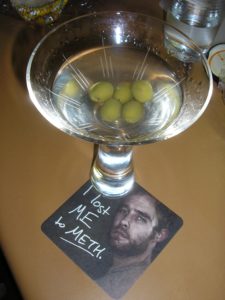
 

Some people are simply pissed off by the campaign because they think that it unfairly singles out gay men, and this will, supposedly, lead the gays to be further stigmatized. In typical fashion, San Diego’s own Gay and Lesbian Times led the charge here:

Now, this is a necessary campaign – meth addiction is an epidemic in the gay community, and, the fact is, meth use is a risk factor in the spread of HIV/AIDS. It eliminates inhibitions, alters judgment, wreaks havoc on one’s personal and professional lives, and has dire health implications.

Another fact to consider, though: meth addiction doesn’t discriminate. It doesn’t single out a gender, race or community – but this ad campaign does.

The important question that must be asked is: does this ad campaign do more harm than good? For the vast majority of heterosexual TV viewers, what message does the campaign send about our community?

Again, it’s no secret: meth is a problem in the gay community, as much as it’s a problem in the straight community, the Latino community, the Native American community, the black community – the risks are as monumental for us all.

But, the well-intended ads, inadvertently we think, send a mixed message; one, that meth abuse is a problem exclusively in the gay community; and two, that the gay community is characterized by drug use and HIV/AIDS.

Why do I use the word “typical”? Because the GLT tends to get their facts wrong, and this is just another example. Here’s the Los Angeles Times on March 14:

The drug, commonly known as “crystal” or “tina,” has been a popular party drug in gay circles since the 1990s. A statewide survey, also released Thursday, found that crystal meth use was 11 times more common among gay men than in the California population overall. Fifty-five percent of 549 gay and bisexual men surveyed said they had used the drug, compared with 5% of the general population.

So, um, meth is not “as much as [of] a problem” in the gay community as the straight community. It’s 11 times worse. That is 1100% worse, if you want to play with the numbers. The GLT is so embarrassing. There are some problems with the “Me Not Meth,” but they aren’t in their focus on gay men. At all.

Anyway, I’m very excited about the shift in my project, and I’m excited about getting my qualifying done. That involves a lot of reading and writing, and then I can write my proposal, which will include, in some form, the following paragraph:

… the governmentality of public health helps to construct gay men as, what I call, risky subjects: neoliberal and sanitary subjects, sexual citizens with a political ethos that connects gendered behavior and subaltern sexuality to a moral regime that promotes individualism and responsibility within, ironically, a culture of hedonism. Since its appearance in the early 1980s, AIDS has been at the center of contestations over biopower, as those who might have, do have, and will probably contract the disease are disciplined, punished, and quarantined. Public health—as well as its surrogates in private healthcare, the ever-increasing number of activist NGOs, and aligned law enforcement agencies—has been charged with not just the modification of behavior, but also, and perhaps more importantly, the construction of subjects. These subjects are not just healthy citizens, healthy Americans, but also productive citizens, responsible, happy, and normal. But what sorts of subjectivities are actually produced? And how? People who are “at risk” for HIV-infection, whether they are men who have sex with men, IV drug and crystal meth users, sex workers, hemophiliacs, or anyone from a disease-ravaged nation, are made into risky subjects with hypercognized biology, bodies, and behaviors. But this is not necessarily (or not always) a negative form of state oppression, despite the tenor of much of the literature on governmentality, the modern form of statecraft that is probably most pronounced in processes of public health. Rather, the history of AIDS shows that both resistance to and collaboration with the governmental public health project has resulted in a slow and steady pushing of the subjected into the subjectors. The public health project is subverted and mutated as the HIV-positive become doctors, gay academics devote their research to HIV and AIDS, and activists, recovering addicts, and former sex workers are professionalized as employees of NGOs and state agencies. Nevertheless, there is no doubt that that there are deeply negative effects of becoming a risky subject, for the mental health ramifications are as potentially insidious as they are deeply under-recognized.

Ya know, in case you were wondering about my theoretical perspective on the whole thing.

Obligatory “Dumbledore is gay” post

Yes, I was surprised that JK Rowling announced to a packed audience that Dumbledore–the wizened wizard of Harry Potter World–was gay. Frank Beekman was there. I was surprised when I read the news, because aside from him being a single headmaster of a British boarding school, nothing about him seemed remotely gay to me. (At least on the page. Michael Gambon’s film characterization is wee bit femme-y.) My gaydar didn’t go off whatsoever while reading the books, which is a problem, considering that there are several hundred characters wandering about through those seven books and none of them were described as even fey. Even wimpy Neville Longbottom, who had the gayest name, turned out to be Mr. Heroic Last Second Man and ended up marrying some other minor female character. So, yes, the Dumbledore being gay was surprising. And utterly awful.

Instead of synthesizing what others have said and making it sound original, I’ll just post some choice quotes, with the occasional commentary.

Gay Prof:

Rowling’s outing of Dumbledore hardly destroyed the closet around the fictional character. On the contrary, she only pointed out how tightly those closet doors were sealed.

If we are to now read Dumbledore’s experiences as those of a gay man, then the image he presents of our lives is an unhappy and empty one. Think I am being unfair? Let’s review the stereotypes that Rowling used to “hint” at Dumbledore’s true desires:

  • His childhood was marked by a violent/absentee father, an overbearing mother, and dysfunctional siblings (Did Rowling consult Freud for her views on homosexuality?).
  • His one and only love interest, Grindelwald, turned out to be a psychopathic killer.
  • His one and only love interest was unrequited.
  • The rest of his life is riddled with loneliness, despair, guilt, and regret.
  • His adult brother, Aberforth Dumbledore, is hinted to be into bestiality (on several occasions) with goats.

Despite his many magical powers, Dumbledore is not much of a queer hero. By the last book, he seems tangled in a web of pathology created by his unhappy homelife. His adult queer desires for Grindelwald are rejected and misplaced.

Indeed, the question at Carnegie Hall that prompted Rowling’s revelation asked if Dumbledore knew “true love” in his life. In response, the author stated, “Dumbledore is gay.” Are we to assume that being gay precludes the possibility of true love? Were Dumbledore’s queer desires not “true love,” but a twisted mistake? This seems more than confirmed when Rowling declared that Dumbledore’s love was his “great tragedy.” Boy, howdy, when has gay love not been perceived of as a tragedy in the hetero media? I’ll just gesture in the general direction of Brokeback Mountain.

Ross Douthat:

It seems like a case of J.K. Rowling trying to retroactively bestow a level of adult complexity on her characters that they don’t possess on the printed page. A writer confident in her powers wouldn’t feel the need to announce details like this after the fact. [Well, she shouldn’t be confident. She’s a hack. The last book was so badly plotted, written, and ended that I was embarrassed to have paid money for it. –Ed.]

Todd’s Hammer:

Rowling may have had the best intentions, but her execution ultimately undermines any attempt that she thought she was making for tolerance, because she gave us a closeted, lonely, dis-integrated character. If she had really wanted to argue for tolerance at the level of sexuality, Dumbledore’s sexuality would have been woven into his character and fully integrated JUST AS IT WAS FOR ALL THE STRAIGHT CHARACTERS. As it happens, she wrote a closeted, pathetic, tragic homosexual character, and then outed him after the fact. She can keep those table scraps.

And, finally, my absolute favorite article is by John Cloud at Time:

But as far as we know, Dumbledore had not a single fully realized romance in 115 years of life. That’s pathetic, and a little creepy. It’s also a throwback to an era of pop culture when the only gay characters were those who committed suicide or were murdered. As Vito Russo’s The Celluloid Closet: Homosexuality in the Movies (1981) points out, in film after film of the mid-century—Rebel Without a Cause; Rebecca; Suddenly, Last Summer—the gay characters must pay for their existence with death. Like a lisping weakling, Dumbledore is a painfully selfless, celibate, dead gay man, so forgive me if I don’t see Rowling’s revelation as great progress.

Am I making too much of this? Undoubtedly. Some of the best Star Trek fan fiction—and there is so much you couldn’t read it all in a lifetime—involves steamy Kirk-Spock love affairs. [As I’ve mentioned in the past. –Ed.] So it will be with the Potter world, as Rowling has acknowledged. Lasting books cease to be their authors’ property; we are now all free to imagine a gay life more whole and fulfilling than the one Rowling gave Dumbledore. But it would have been better if she had just left the old girl to rest in peace.

And that’s that. Thanks, JK, but, really, you should have kept it to yourself. Or written better books.