Do we really want to go back?

Trainspotting is the great film of the 1990s counterculture, its decade’s Easy Rider or Rebel Without a Cause. The tone poem about heroin addiction, friendship and the idiocy of youth among the Scottish working class arrived in the United States in the summer of 1996 laden by the weight of a Miramax publicity juggernaut, the massive popularity of Irvine Welsh’s novel of the same name and a burgeoning moral panic. Mothers and politicians were ringing their hands over a new heroin epidemic that had either been presaged or revealed by the heroin chic of Kate Moss and James King.

Opportunistic pundits argued that Trainspotting glamourized heroin, while people who had actually seen the film argued that it did just the opposite by providing us with some of the most indelible images of drugged degradation and sorrow in Western culture. The film catapulted to fame its stars Robert Carlyle, Jonny Lee Miller, Kelly McDonald and especially Ewan McGregor while announcing Danny Boyle as one of the great directors of the era. The film is a wildly imaginative kaleidoscope of music cues, tableaus and postmodern pastiche; it’s beautiful, horrifying, hilarious and deeply sad.

Why on earth would you make a sequel? It would seem like a bad idea: the first film was too iconic, the stakes would be too high. Welsh wrote a sequel called Porno and Boyle and Trainspotting screenwriter John Hodges almost made it in the mid-2000s, but Boyle has said, rather bluntly, that “it felt really not-good-enough, so we abandoned it.” Welsh’s story was an uninspired caper, and Boyle felt they were only making it for the money. After ten years pondering, Hodges and Boyle came up with something that was neither silly nor cynical. T2 Trainspotting is an inspired meditation on the very personal experiences of guilt and nostalgia and the culturohistorical problems of alienation and the ravages of capitalism.

Twenty years after the end of Trainspotting, after he stole the proceeds of a heroin deal from two of his friends, Renton (McGregor) returns to Edinburgh. He’s there to reconnect with his family and Spud (Ewen Bremner) and Simon, also known as Sick Boy (Miller). Renton had secretly given Spud his fair share of £4,000 (which Spud promptly shot up his arm), but he’d stiffed both Simon and their sociopathic compatriot Begbie (Carlyle). Renton arrives just in time to stop a despondent Spud from committing suicide, and when he finds Simon, who has traded heroin for cocaine, the two have a vicious, but slapstick, barroom brawl, and Renton gives him the money he’d stolen.

Along with Simon’s arch, wise-beyond-her years girlfriend Veronika (Anjela Nedyalkova), Renton, Spud and Simon revisit their friendship under the backdrop of the collapse of Edinburgh’s council houses and encroaching gentrification. Simon is secretly planning to betray Renton at some point as revenge, but when Begbie shows up, escaped from jail and struggling to connect with his son, he protects his friend with a complicated lie. Eventually, the schemes, lies, drugs and their various levels of competence at dealing with the modern legitimate world collide in a mess that seems quite fitting for our antiheroes.

T2 could not possibly be what Trainspotting was: a revelation, a representation of the zeitgeist. But in jettisoning Welsh’s parochial nihilism, Boyle and Hodges have made a movie about something much bigger than addiction and loyalty. They are bemoaning both the isolation of our hyper-mediated, deeply shallow culture and our nostalgic yearning for a past that never really existed. In giving us more complex versions of these famous characters – even Begbie’s behavior gets sympathetically explained – their plights seem more like our plights and thus more moving and more upsetting.

Renton’s revision of his classic “Choose Life” monologue that opened the previous film is a sublime and devastating ode to the loneliness and hopelessness of late capitalism. In having characters revisit the locations of many of the first film’s scenes while also strolling through the ruins of the British welfare state, the film both embraces and mocks its characters’ nostalgia. The characters do it, too: Simon snidely derides Renton’s too-fond memories of their youth in one of the film’s darkest moments. I felt implicated, too. Hodges and Boyle seem to be criticizing the audience for trying to rekindle its romance with Trainspotting and 1996. Do we really want to go back?

T2 Trainspotting
Directed by Danny Boyle
Written by John Hodge
Starring Ewan McGregor, Ewen Bremner and Jonny Lee Miller
Rated R

Originally published in LGBT Weekly
Laugh, cry, furious, proud


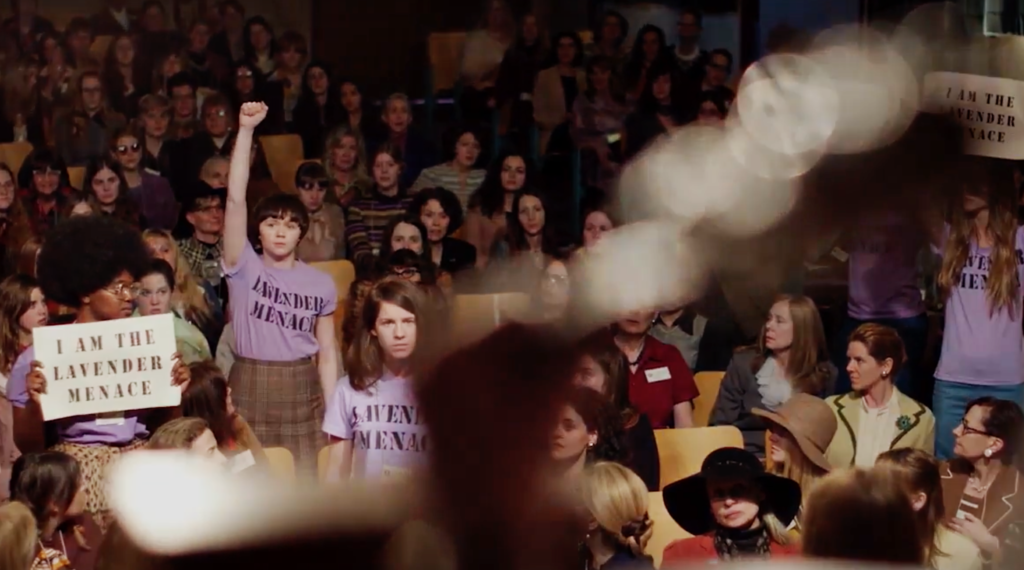
Emily Skeggs as Roma Guy in When We Rise

When I heard that ABC was going to do an eight-hour miniseries about the gay rights movement – a sort of Roots for the gays – I was shocked. Dustin Lance Black, who won an Oscar for writing Milk, was shocked, too, when he found out ABC was asking for LGBT-themed pitches. But he went to the meeting and proposed When We Rise, which took ABC’s primetime schedule the week after the Oscars (the one that ended with the first gay-themed Best Picture winner). It was an incredible investment of resources to an unflinching and honest portrait of the messy, upsetting, tragic, uplifting and subversive lives of LGBT Americans.

The series isn’t as groundbreaking as Roots and not as artful and sublime as Milk, but it’s a damn fine docudrama that should make you laugh and cry, make you furious and make you proud. If you missed when it was on live, you’re in luck: It’s sitting on Hulu in perpetuity.

When We Rise starts in 1972 with young activists converging in San Francisco and ends in 2013 with them celebrating marriage equality at San Francisco City Hall: Cleve Jones, a gay teenager from middle-class Phoenix becomes Harvey Milk’s aid and the founder of the AIDS Quilt; Roma Guy, a Peace Corp veteran, starts the San Francisco Women’s Building, raises a daughter with her longtime partner nurse Diane Jones and helps usher in citywide health care; and Ken Jones, a black Navy officer and Vietnam veteran runs a homeless center, becomes an addict, and then a central figure of the progressive queer church City of Refuge. All are real people who participated in the making of the series, which is officially “suggested by” Jones’ recently published memoir.

Cleve is played by Austin P. McKenzie as a young man, then Guy Pearce. Emily Skegs and then Mary-Louise Parker are Roma, with Fiona Dourif and Rachel Griffiths as Diane. And breakout newcomer Jonathan Majors and then Michael Kenneth Williams are Ken. (Various other historically important people are played by Ivory Aquino, TR Knight, Dylan Walsh, Whoopi Goldberg, Phylicia Rashad and Rosie O’Donnell.)

Clockwise: Austin P. McKenzie as Cleve Jones, Jonathan Majors as Ken Jones, Guy Pierce as Cleve Jones and Mary Louise Parker as Roma Guy, and Whoopi Goldberg as Pat NormanWhile the resemblances between the younger and older actors are minimal at best, with Cleve’s making the most sense and Roma’s almost none, the suspension of disbelief is earned over the eight hours of extraordinary plot both historical and melodramatic. As the three young activists get involved in local queer politics, they crisscross each other and find their voices, fall in and out of love, fight the power and each other, and then confront the epic tragedy of AIDS. The four of them survive, the men do it just barely, and then they all experience various forms of catharsis.

That all of these things happened over such a short period of time is amazing, but Black shows how organically they occurred, accidents of history abutting brilliant activism and masses of love and anger. He does not shirk the truth: There is gay sex, gay bashings, deaths from AIDS and fury at the people who let us suffer and die. Black’s dramatization occasionally takes shortcuts, both historical and emotional, and a few times the action feels forced and the tears manipulated. I cried through most of the second four hours: the deaths, the marriages, the redemptions. When I posted that on Twitter, Black liked it: He wanted me to cry.

I’m not sure if everyone will cry while watching When We Rise. Those of us who lived through it will likely have profound emotional reactions: the depictions of the events are true enough to, for lack of a better term, trigger floods of memories.

If we’re lucky, however, people who didn’t know it was all happening or weren’t born early enough to participate will see When We Rise and learn something, feel something and develop the empathy, understanding and anger needed to make sure we don’t go backwards. You should watch it, and you should watch it with the people who need to see it.

When We Rise
Written by Dustin Lance Black
Directed by Dustin Lance Black, Gus Van Sant and Dee Rees
Starring Guy Pearce, Mary-Louise Parker and Michael Kenneth Williams
On Hulu

Originally published in LGBT Weekly

In all its messy, bloody, thrilling glory

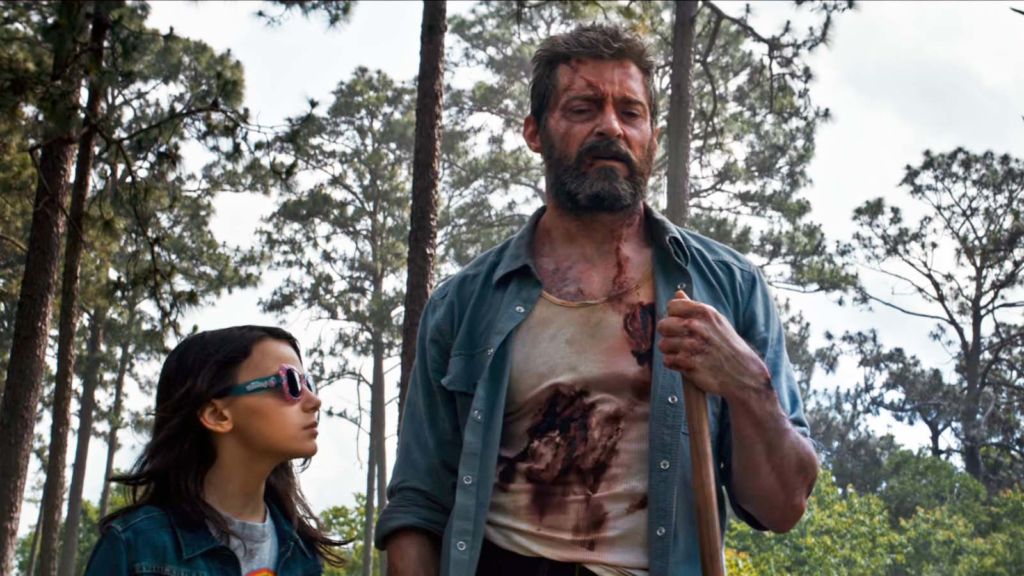
Dafne Keen and Hugh Jackman in LoganI received my first issue of The Uncanny X-Men in my Christmas stocking in 1985. I was 10, and it was the comic that all of my friends were reading. These boys were fixated on Wolverine, the cigar-chomping killing machine with unbreakable bones and long metal claws. He seemed to be half wild animal, half Charles Bronson in Death Wish.

A deeply sensitive and conflict adverse proto-gay, I was unnerved by Wolverine’s violence and unpredictable rage, and I was much more enamored by weather witch Storm and teen genius Kitty Pryde; their stories moved me when Wolverine’s scared me.

But Wolverine was and is the most popular of the X-Men. This isn’t just because the teenage boys who are the majority of comics’ readers love hyper-masculine violence. As the years went by, the writers and artists of the various X-Men titles turned Wolverine into an emotionally complicated, psychologically tortured, and reluctant hero who works in the grayest areas of the moral universe.

I read through many of these stories as a less fearful adult, and it’s this complexity that has made me love the character so much. But when he finally ended up on the big screen in 1999, with Hugh Jackman perfectly cast, the pressures of family-friendly film franchising sanded down Wolverine’s roughest of edges. Or, the edges were there and the films’ mundanity covered them with a polyurethane sheen.

Then comes Logan, the third Wolverine film, ninth appearance of the character on the big screen, and Hugh Jackman’s last time playing the role. Logan is not only one of the best X-Men films – if not the best – but it’s also the best representation of the Wolverine character in all its messy, bloody, thrilling glory.

The new film was inspired by the now classic graphic novel Old Man Logan, but departs from that text in many ways, which will disappoint that title’s ardent fans. It is several decades in the future, mutants have mysteriously stopped being born, and Logan, whose nom de guerre is Wolverine, is grayer, limping and coughing, his mutant healing ability clearly no longer adequate. He is working as a limo driver, trying to save money to buy a boat where he can take a decrepit Charles Xavier (Patrick Stewart), also known as Professor X, as he dies of something like a cross between Alzheimer’s and epilepsy.

Patrick Stewart in Logan

The most powerful telepath alive, Charles’ seizures are like psychic bombs, so Logan and the albino mutant tracker Caliban (Stephen Merchant) keep him drugged and hidden away across the border in the Mexican desert, away from innocent bystanders.
One day, a Mexican nurse named Gabriela (Elizabeth Rodriguez) finds Logan and tries to hire him to take her and a young mutant named Laura (Dafne Keen) to a haven for mutants in North Dakota. Logan is resistant, even though Charles is insistent that they help. When a pack of vicious mercenaries called the Reavers show up and Laura slaughters more than a few with very Wolverine-like abilities, Logan reluctantly agrees.

The basic plot is very “Just one last job!” but director James Mangold (3:10 to Yuma and Walk the Line) and co-writers Scott Frank and Michael Green use that structure to investigate Logan as a character without much cliché; through crackling dialogue and one exhilarating set-piece after another, we watch Logan wrestle with mortality, guilt, filial piety and his own instinctive brutality. His interactions with the mostly mute Laura are funny, gruff and moving, giving filmgoers the first glimpse of a side of Wolverine so important in the comics and absent from the films: his counter-intuitive mentoring of teenage girls like Kitty Pryde and Jubilee.

The film also showcases extreme, sometimes jaw-dropping violence, earning the film its R-rating by a mile and then some. It makes Deadpool seems like a Tom & Jerry cartoon. But this violence, which is perpetrated not only by Wolverine but also by a pre-teen girl, is what makes Logan’s physical and psychological pain so believable. It is also what makes his redemption so powerful. For the first time in 30 years, an X-Men story earned my tears.

Logan
Directed by James Mangold
Written by Scott Frank, James Mangold and Michael Green
Starring Hugh Jackman, Patrick Stewart and Dafne Keen
Rated R

Originally published in LGBT Weekly

“Campus Rape Hysteria”

I came across this sign on the way to one of my lectures this past week. It irritated me, and I took this picture to show a friend later. But then one of my students came up to me after class and told me how she was being sexually harassed by another student in a particularly vulgar way. And I got angry. As anyone who is paying attention knows, Trump’s rise and election has emboldened the people who had previously been quiet about their misogyny, racism, and jingoism. While I can’t directly blame Trump for my student harasser or for this event, I can state without much doubt that discourse about sexual harassment and sexual assault has devolved over the last year. And if we don’t call it out, it will get worse. Here’s me calling it out. I’ve annotated the sign to point out all of its problems, obvious and not.
[image_mapper id=”2″]

The art and irony of The Salesman

Taraneh Alidoosti and Shahab Hosseini in The SalesmanOutside of cinephiles who have seen his Oscar-winning A Separation, Asghar Farhadi is not well known among Americans. But his name was thrust into the news over the last few weeks because of President Trump’s executive order banning travel of most anyone, but particularly Muslims, from seven majority Muslim countries. (The list does not include any majority Muslim country where Trump and his family have business dealings. Of course.) Because of the ban, Farhadi, who is from Iran, cannot travel to the United States for the Academy Awards, where his newest film The Salesman is up for Best Foreign Language Film; even if the stay of that order allows his visit, Farhadi is boycotting in protest.

There is a great deal of irony in preventing the director of The Salesman from attending the Oscars. By setting a suspenseful revenge drama among the cast of a Farsi-language production of Arthur Miller’s Death of a Salesman, Farhadi entwines Iranian and American emotional and moral experience. That such a tale comes from Iran, described as part of the Axis of Evil by George W. Bush and repeatedly threatened with destruction by Trump, is situationally ironic in that it is the opposite of what many people expect from our supposed enemy. It’s dramatically ironic in that Trump seems to have no clue whatsoever that Farhadi exists, that our most human complexities are universal or that both Iranians and Muslims are humans. (There are also the weird similarities between Miller’s Willy Loman and Donald Trump, both delusion narcissists, but since Trump doesn’t read, watch anything by Fox News or have the capacity for self-reflection, it’s unlikely he could have made that connection.)

However, even if Farhadi is not attending the Oscars, The Salesman is in theaters across the country. (Trump will probably be unable to ban films made by Muslims, women or scientists, but no one should think he’s not going to try.) Emad (Shahab Hosseini) is a high school teacher and actor who is playing Willy Loman in Death of a Salesman; his wife Rana (Taraneh Alidoosti) is playing Linda, Willy’s wife. After their apartment building becomes physically unstable and is evacuated, they move into an apartment owned by one of their fellow actors. The owner neglects to tell them that the previous tenant was a prostitute, and shortly after Emad and Rana have set up house, one of her former clients attacks Rana while she is taking a shower and Emad is out buying groceries. At first Emad thinks she had just fallen, and then the neighbors who took her to the hospital tell him she was attacked. It’s implied but never clear that she was raped, and Rana is too ashamed and traumatized to fully explain everything to Emad. All of this weighs on Emad as he seeks out the perpetrator and tries to keep calm while he is portraying Willy Loman each night.

The film is ingenious in its pacing and its use of Arthur Miller. The tension is slowly increased through misdirection, ambiguities and a smart lack of a score that would indicate what emotion we’re supposed to feel or expect. I had no idea what was about to happen at any point in the film, particularly in the last act when Emad seems to have found Rana’s attacker. In an American film, the revenge would be brutal (see: Prisoners, Kill Bill, Enough), but Farhadi flips the genre on its back and makes the emotions, but not the action, violent.

Taraneh Alidoosti in The SalesmanDeath of Salesman seems to have no clear connection to the film’s plot until the last 20 minutes. Then, Miller’s commentary on obligation, illusion, sacrifice and failure are reimagined through Emad and Rana’s acting out of their moral duties as well as an American play. If there is any justice, publicity over Farhadi’s absence from the Academy Awards will lead American audiences to experience his art and his insight into America’s greatest drama.

The Salesman (original title: Forushande)
Written and Directed by Asghar Farhadi
Starring Shahab Hosseini, Taraneh Alidoosti and Babak Karimi
Rated PG-13
In Farsi with subtitles

Originally published in LGBT Weekly